

Dancing has been a part of Philadelphia society since its founding. At the same time, during the 18th and 19th centuries, the city experienced strong religious opposition. Quakers believed social dances were shameful and forbade their children from attending balls and parties. Find out more at philadelphiaski.com.
Other representatives of the wealthy aristocracy gathered in private homes to dance. Subsequently, hotels and restaurants began to organize the balls. In the middle of the 18th century, the city even established a dancing assembly. Over time, as the dancing gained popularity, Philadelphians picked up new skills and followed the trend. This form of entertainment became popular in the 20th century and is still a significant component of urban culture today.
Dancing in Philadelphia: fors and againsts
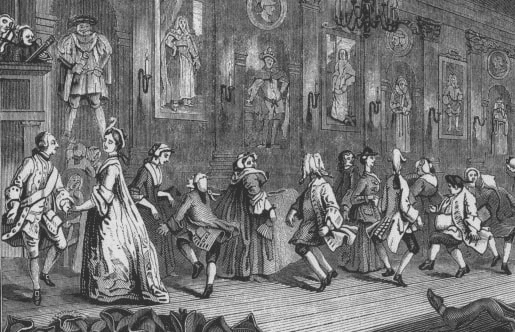
Country dance, introduced by English workers, was the first popular dance style in the city. It was a lively, fast-paced rural dance. It was not accepted by the Quakers, who were opposed to parties in this style.
At the same time, children from aristocratic families learned European dances like the quadrille and minuet. They were brought to the area by teachers fleeing the French Revolution. During the dances, the partners changed frequently, making it difficult for them to communicate. As a result, this type of dance was deemed morally acceptable.
In 1748, the city established the Philadelphia Dancing Assembly. It was an exclusive community that hosted formal social balls similar to those held in London. It’s interesting to note that the townspeople danced not only the minuet and quadrille but also country dance. Furthermore, the events provided entertainment for those who did not want to dance but still wanted to attend the ball. Therefore, visitors could play cards and enjoy delicious food and drinks.
Representatives of the Assembly sent membership invites. After paying the fee, you could attend the ball. During the first year of operation, the organization had 59 members, each of whom paid forty shillings. The first to be invited were representatives of the elite and Jewish families. Only Quaker families remained on the sidelines, continuing to oppose such entertainment.
Dance lessons and the first charity ball
At the end of the 18th century, Philadelphia saw the emergence of dance schools, offering a range of dance lessons. For example:
- London choreographer James Byrne and his French colleagues taught dance at Oeller’s Hotel
- a dance school operated at Harmony Hotel
- in 1847, dancer and actor Charles Durang published a dance guide for a wide range of readers.
At the start of the 19th century, the city began to dance the waltz, a fashion for which came from Europe. The Quakers again objected to it because the dance allowed for close contact of partners. As a result, the waltz gained popularity among the working class, and the aristocracy danced it changing the dynamics of couple interaction.
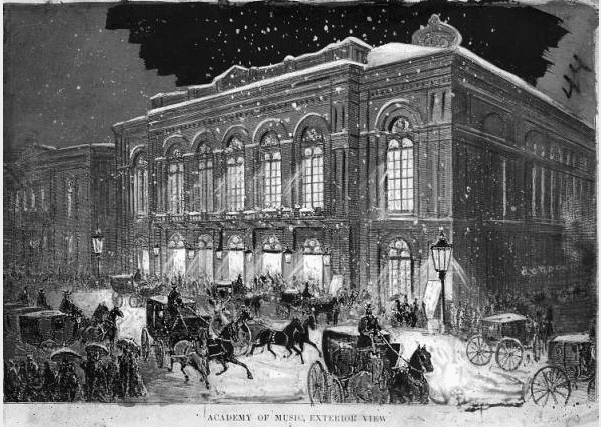
In 1881, the city hosted its first charity ball. This event had grown to be large-scale and extremely beautiful. It was hosted at the Academy of Music, which was converted into a real greenhouse. The orchestra performed from 10 p.m. to 3 a.m. Customers were treated to an exquisite dinner. During the evening, $12,597 was raised for the Hospital of the University of Pennsylvania. Since then, the charity ball has become an annual event, helping promote a positive attitude toward dancing, which contributed to a good deed.
New dance styles in the 19th and 20th centuries
In 1844, the first polka sheet music was introduced in Philadelphia. This lively dance immediately became popular. It resembled a slightly softer country style yet remained upbeat. The waltz gained even more popularity.
At the beginning of the 20th century, choreographer Charles Frank established his own dance academy, where students learned the waltz, foxtrot and other dances. In 1922, he published a book on how to learn to dance at home.
At the same time, the anti-dance movement persisted. The waltz was especially despised among Quakers, who believed it exposed girls to corrupting influences. As a result, a conflict of contradictions and opposing viewpoints remained in society, which was eventually settled by businesses.
establishments may help them develop and become more popular. They began to build special dance venues and even separate halls. At the same time, African Americans began to popularize ragtime and organize dance competitions. In addition, swing and other dance styles emerged.
The Philadelphia Association of Teachers of Dancing, founded in the 1890s, attempted to regulate the forms and styles of dance in the city, but this effort failed. Young people began to break free from family restrictions, and social dancing became an integral part of middle-class social life.
In the 1920s, Philadelphia orchestras presented free social dance concerts in Logan Square every Thursday. Residents in Philadelphia began dancing the foxtrot and tango, and the number of dance studios expanded. So, in the end, resistance to the popularity of dancing was overcome, and Philadelphia emerged as a vibrant dance metropolis.