
The city’s main sports arena formerly held numerous great tournaments, concerts and cultural events that are now part of history. Here, someone made their professional start, became a champion and someone suffered painful defeats. Citizens of the city were able to witness all of this from the stands of their home stadium. Regardless of racial stereotypes, social status or workplace issues, everyone came to the Philadelphia Arena to experience the spirit of unity. Read more about the history of the large-scale Philadelphia sports stadium and what happened to it in the end at philadelphiaski.com.
Founding and development of the arena
The founders of the sports complex are said to be the administration of a local radio station. They were the ones who launched the construction of an ice palace next to their station in 1920, which eventually turned into a TV studio. On February 14, of the aforementioned year, the Philadelphia Ice Palace and Auditorium was officially opened.
The stadium’s construction was overseen by a man called George Franklin Pawling. The man was the chief engineer and the driving force behind all the concepts that sprang to life at breakneck speed. Therefore, George was one of the honored guests at the first sports game held on the grounds of the new stadium. Then, on the ice, teams from local universities clashed.
At the time, the sports complex could only seat up to 400 people, and there were some issues with the entry – there was only one door. However, the establishment of such infrastructure eventually provided impetus to the growth of all sports in Philly.
After a while, the arena became the home venue for three university hockey teams: Yale, Princeton and Penn. The latter did not have such a sports infrastructure in their city, so they had to pay rent and travel to Philadelphia.
The sports palace acquired a new name and began to be known as the Arena in 1925, as well as getting new owners. Jules Mastbaum, who owned a movie theater chain, was first in charge and later sold the sports stadium to Rudy Fried and Maurice Fishman. The latter were in charge of operations until 1934 when Peter Tyrrell took over the company. Tyrrell was another manager of the arena until 1958, and he was the only one who returned the organization to profitability, enhancing its sporting potential.
Major events and stadium decline
In general, the arena was used primarily for sporting events. Though occasionally, historical or cultural events took place here as well. For example, the inauguration of a mayor or religious organizations’ activities.
When it comes to athletic events, of course, the residents recall Sonja Henie’s professional debut and Roy Rogers’ first rodeo. Though, there were unfortunate events too. Once, during a competition, there was an accident in which a girl died after falling from a horse. In honor of the young girl, a prayer was sung right in the arena.
The sports infrastructure was mostly used as an ice arena, since it was the home stadium of numerous local hockey clubs, among others.
Citizens could also watch a variety of boxing competitions, including those featuring Primo Carnera, Sugar Ray Robinson, Joe Frazier and others.
In 1947, the Arena, along with the NBA franchise and basketball team, was sold to Triangle Publications. Following that, the sports stadium went back to Tyrell, who solicited the financial assistance of friends who had their own businesses. When the entrepreneur retired, the arena was auctioned off to the sports concern James Toppi Enterprises.
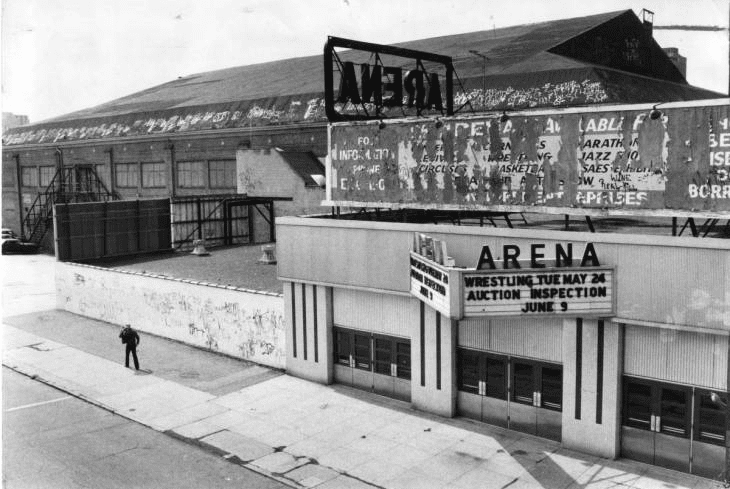
Due to the construction of the Spectrum building in the 1970s, the structure was no longer in use. As a result, there was a crisis in the Arena’s history, the structure fell into decay. It remained operational for several years thanks to a new owner who preserved the city’s historical legacy and recruited new investors, even renaming the stadium in honor of Martin Luther King Jr.
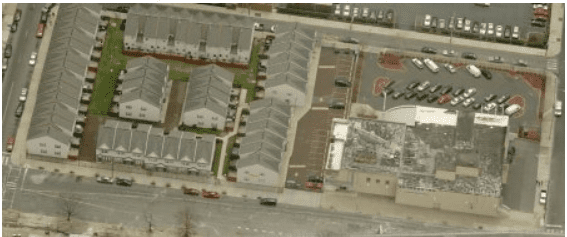
The arena was finally demolished on August 24, 1983, as a consequence of a fire in an old structure. In 2007, a townhouse was built on the site of the place where sports competitions were once held.